This story originally appeared in the Napa Valley Register.
The 69th Primetime Emmy Awards took place this past week. The celebrities were out in full force, dressed in their very best, for a night of glamour and recognition. Naturally, with all the celebrating, there were a lot of toasts being made. And with each toast, the glasses were filled with Ferrari Trento sparkling wine, adding a touch of Italian style to the night.
Italy’s most awarded bubbles, Ferrari Trento was the Official Sparkling Wine of Emmy® Awards season for the third consecutive year. Named the “European Winery of the year” by Wine Enthusiast in 2015 and the “Sparkling Wine Producer of the Year” at The Champagne and Sparkling Wine World Championships, Ferrari Trento understands what it is to be the best. Featured in world-class restaurants around the world, Ferrari Trento is also partnered with luxury brands Zegna and Maserati. After all, Ferrari Trento is a brand the celebrates the “Italian art of living.”
But Ferrari Trento is a family-owned business. Ferrari Trento was founded by Giulio Ferrari in 1902 who had studied in France, where he learned about Champagne and the metodo classico (Champagne-method). Returning to Trentino, Giulio Ferrari was the first person to understand the potential of the Trentino mountains and was the first to bring chardonnay and pinot noir to the area. Giulio Ferrari ran the winery for 50 years and every bottle he produced was a work of art.
Unfortunately, Giulio Ferrari did not have any heirs so he decided to sell the winery and selected Bruno Lunelli, a wine merchant in Trento, as successor. The Lunelli family took over in 1952 and today, President and CEO Matteo Lunelli is the third generation to run the winery.
This story originally appeared in the Napa Valley Register. When you think of German wine, you most likely think riesling. And when you think of riesling, you probably think sweet wine. Yes, there are sweet styles but not all riesling is sweet. In fact, there are many dry rieslings, and dry wine is what the German people prefer to drink. So, how can you tell when a riesling will be sweet or dry? By the labeling. The labeling of German wine that you might be most familiar with, and the most confused by, is their Prädikat wines, which are based on ripeness level designation, such as kabinett, spatlese, auslese and beerenauslese. But in 2002, and then updated in 2006 and again in 2012, the VDP, an association of Germany’s best producers founded in 1910, established a new classification system based on the Burgundian system of Grand Cru and Premier Cru vineyards. Germany has four tiers – Grosses Gewächs (Grand Cru vineyards), Erste Gewächs (Premier Cru vineyards), Ortsweine (village level) and Gutsweine (estate wines). Gross Gewächs vineyard sites are where the best dry riesling comes from, and they are noted on the bottles with an embossed GG. The small region of Nahe, as I discovered on a recent trip to Germany, has a vast array of dry rieslings. Nahe, located between the Mosel and the Rhine Valley in southwest Germany, used to be part of the Rhine but was declared an independent region in 1971 and started to get interest 20 years ago. Located at the 41-45 parallels, Nahe is more northern than Canada. The temperature in Nahe is mild, with lots of sunshine and low rainfall, allowing the grapes to fully ripen and be vinified dry. What sets Nahe apart from other regions is its geological diversity. There are 180 different soil types within the 4,000-hectare region. This wealth of soil types includes quartzite and slate in the lower valley near the Rhine, porphyry, melaphyre and colored sandstone in the central valley and weathered soils and layers of clay with sandstone, loess and loam in the higher valley.
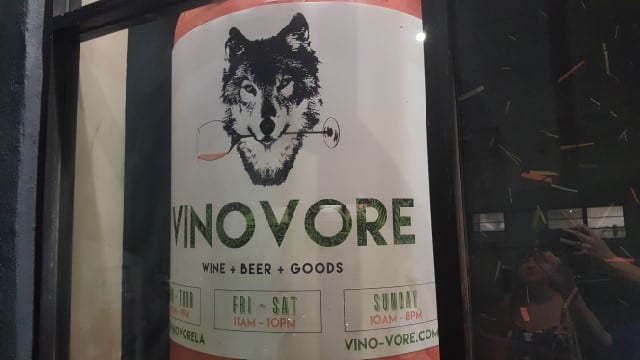
Located on a yet-to-be-developed street in Virgil Village in Silverlake, Vinovore is a brand new specialty wine shop. The store is not very large, about the size of a comfortable living room, and is home to approximately 150 different wines, with plans to grow to 250 in time. But there are two unique elements to this wine store that set it apart from anything else in Los Angeles and that is why Vinovore is the Please The Palate pick of the week. Vinovore is co-owned by Coly Den Haan, a sommelier who previously owned The Must and Perch in downtown LA. With her partner Dean Harada, a developer, they own Hot Hot Food just up the street (and really the only other business currently on the street). The first thing that makes Vinovore unique is that 90 percent of the wine selection happens to be made by women winemakers. With a strong emphasis on female winemakers, there are wines from California, Washington, Oregon, Finger Lakes, Italy, Spain, France, Portugal, New Zealand and Australia. I think it is wonderful that there are so many female winemakers out there and at this store, I will be introduced to more than the ones I already know! While it is important to note that wine is not any better because it is made by a woman, I think it is wonderful to highlight female winemakers in an industry that is still rather male-dominated.
Copied!