
This story originally appeared in the Napa Valley Register.
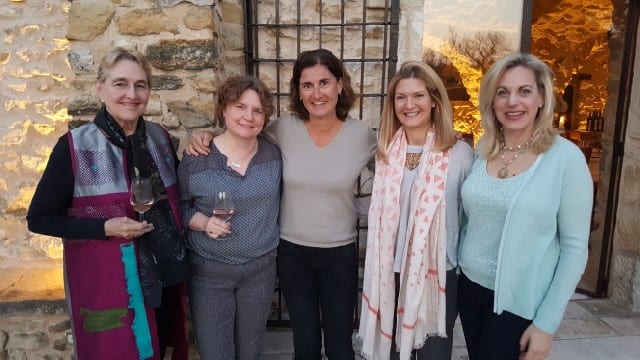
We are bombarded of late by the news of men abusing their power. It can be overwhelming to listen to story after story after story about how men treat women. It is important to remember how many extraordinary women there are and many of them work in the wine industry. As I was thinking about this, I was reminded about my visit to Chêne Bleu Winery earlier this year.
Located in the Rhone Valley, with one foot in the northern Rhone and one foot in the southern Rhone and at the crossroads of four appellations: Gigondas, Cotes du Ventoux, Cotes du Rhone and Sequret, Chêne Bleu Winery is the project of the Rolet family.
Xavier and Nicole Rolet purchased the property in 1993 and spent the next 10 years restoring and renovating the 340-acre estate to include vineyards, the winery and Le Verrière, the former priory that now offers guest bedrooms and suites.
And, while Xavier (proprietor), and his brother-in-law Jean-Louis Gallucci (winemaker, cellar master and chief problem solver) are both key members of the team, at the heart of Chêne Bleu Winery is a team of extraordinary women.
I spent the past week eating and drinking my way through Porto and the Douro in northern Portugal. There were so many wonderful wines, from still white and red Douro wines to the famous and historical Ports, both ruby and tawny. But at each and every tasting, the one wine that stole my heart was the Colheita and that is why it is the Please the Palate Pick of the week. Port can be ruby or tawny. Ruby Ports, whether young, reserve, LBV or vintage, tend to be more fruit driven as they do not age in oak. A tawny port is a port that is aged in wood so that oxygen flows through resulting in the loss of color and the development of different flavors. Tawny Port is available in 10 Year, 20 Year, 30 Year, 40 Year and Colheita, an aged Tawny Port made with grapes from a single vintage. "Colheita" means "harvest" in Portuguese. Colheitas are required by law to mature in wooden casks for at least seven years, although it can be much longer. The wine is bottled when the producer feels it is ready to drink.
This story originally appeared in the Napa Valley Register.
I was recently in New York to help organize a trade tasting of Texas wines.
When I was asked to work on this, I was intrigued. I knew they made wine in Texas but had not yet tried one. But I was also curious. I was curious in the same way many of us who live in California might react. Texas wine? Really?
I am aware that wine is made in almost every state in the U.S. But when I think about climate challenges, I wonder why a winemaker would be drawn to making wine in a lesser-known region that is not already known for wine and faces humidity, frost and disease as a regular occurrence.
When I was introduced to Virginia wines, I had had that reaction. But in my visits to various wineries in Virginia, I began to understand when I found dedicated people, some who had previously worked in California and other well-known wine regions, who found a home in a developing region.
As I sat down to dinner with the Texas winemakers in New York the night before the event, I was able to learn more about Texas wine.
Copied!